HIST 100: Engineering The Past

  • Home
  • Syllabus
  • Schedule
  • Blog

Concept Map

March 3, 2016 by amandalennox Leave a Comment

I, like many others, decided to compare religion but more specifically religious practices. I did the religions of Catholic, Christianity, Shinto, Buddhism, Hinduism, and Islamic. As I wrote down facts of each and starting comparing and contrasting what each religion does differently there are of course, those that are very similar to each other. One pair are Buddhism and Hinduism. Both religions practice more relation techniques like meditation, and devotion to their deities.  The Islamic culture is very different however. The Islamic religion practices religion by the Five Pillars, mosque services on Fridays and they stay abstinent of alcohol and pork. When comparing when the religions get together to practice worship in groups, I did find it strange that some did so on different days of the week. For example, Christianity practices on Sundays and Islamic on Fridays.

 

IMG_9642


Filed Under: 0.0 Concept Map Assignment, Group 5

Recommendation to Middle East

March 3, 2016 by amandalennox Leave a Comment

If I could rewind time and go back to the days when the Middle East first was starting up and I had the opportunity to change the way the leaders ran the economical issue of water resources, I would. I would start by being sympathetic to the leaders for a better chance they would actually listen since they seem to be very straight forward and don’t care about what you have to say unless it is something that will help them develop to become better.

In the Middle East, aquifers are used very greatly in their economy. Aquifers are underground sources of water which have been formed over thousands or even millions of years: whilst they can be partially recharged by rainwater seeping into them, they are essentially non-renewable. Many other sources that would potentially help with the water scarcity, like drip-irrigation, are too expensive for more in poverty countries like Iraq or Syria. I believe that is countries like specifically, Syria were to manage their water resources more effectively then scarcity would not be as big of a problem that it is now.

Obviously, there’s no way of controlling climate and mother nature, besides global warming that is said to have a greatly big impact on the climate change, but there are ways to still manage to get by. The problem with Syria right now is that farmers are being put out of their business and going into poverty and creating riots of mass destruction in urban areas. However, if there could be a way to go back in time before the water scarcity, I would say let the farmers grow something a country, that is rich in water, is in need of and trade. However, there are bigger problems that can come into play such as political issues but I believe it would be a good start since the aquifers no longer can have a use since they run off of rainfall.

To really be able to get my point clear and understood I would ask for all past history of global warming rises in the specific areas of concern, Iraq and Syria, and see how they have risen over the years and try to see if there would be a way to predict the outcome of climate change. I would also ask for the amount of water being used for certain things. I know in Iraq, 80% is used for irrigation, but to be put into even smaller categories to help break it down more and try to conserve more water. Something else that could be helpful would be a break down of how the aquifers were made. If one knows how they were made, then maybe there could be a way to alter how water gets to them and a solution could be made from that. All of these pieces of information could most likely be found from the government of the specific areas since most of it is in mass numbers and some are private.

Filed Under: 08.2: Middle Eastern water woes, Group 5

Other Large Structures

February 9, 2016 by amandalennox Leave a Comment

FullSizeRender (1)

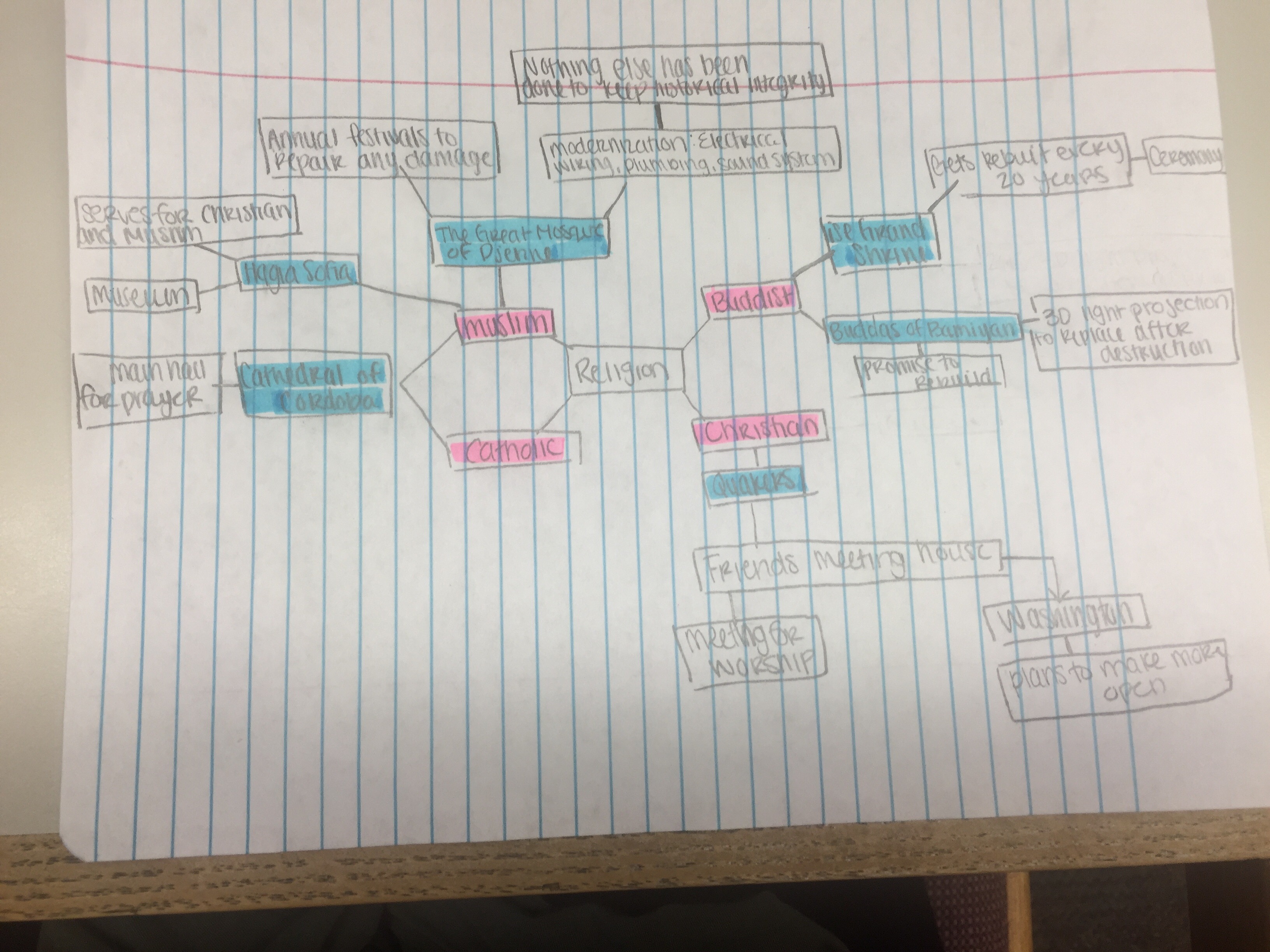
The Great Mosque of Djenne was part of the muslim religion. It was considered an adobe building which means it was made of material from the earth and often organic. The walls were made from sun-dried earth bricks, sand, earth baked motar. Its structure is 3 symmetric arrangement of 3 large towers. There are annual festivals where all gather for music and food and to repaid any damages that may have occured in the past year.

The Cathedral of Cordoba was divided between the Christian and then Muslim. Later on it was converted to Roman Catholic. It is made from pure gold nails and red marble columns. the main hall serves for prayer of any kind. Architecture is similar to that of the Great Mosque of Damascus.

Ise Grand Shrine is rebuild every 20 years and have a ceremony to celebrate thereafter. The present building was built in 2013. The architecture style is that of Shinmei-Zukuri which demonstrate simplicity and antiquity.  It is built with Japanese cypress trees with a raised thatched roof. The roof absorbs water in rainfall and becomes heavy and closes any gaps to keep the inside dry. During summer time the roof will dry and become light again.

The Buddhas of Bamiyan are very treasured statues whos bodies are made directly from the sandstone and details from mud mixed with straw and coated with stucco. They were destroyed by the Taliban in 2001 and now there are promises to rebuild. After destruction there were 50 caves discovered and 12 of the caves had ancient paintings inside. In 2015, there was a 3d light projection made to resemble the destroyed artifacts.

The friends meeting place is a place where Quakers were to meet for worship. Those referred to the word “church” to the body of people who make up the worshipping community. They are known for their simplicity, equality, community and peace.  The structure itself manifested and enhanced the Quaker Testimonies and the cultivation of the Inner Light that was essential to the Friends.

Renovation of the Washington meeting place include an elevator and more modern technology. They want to make it more open for campus and to have the Meeting Place on the left and the Quaker house on the right. They wish to expand to allow for more things to occur.

Filed Under: 04.2 Other sacred structures - visualization, Group 5

  • « Previous Page
  • 1
  • 2
  • 3
  • 4
  • 5
  • Next Page »

Students

Log in here.

Groups

Student Contributions

From the Professor

Copyright © 2026 · Minimum Pro Theme on Genesis Framework · WordPress · Log in