HIST 100: Engineering The Past

  • Home
  • Syllabus
  • Schedule
  • Blog

Concept Map

March 1, 2016 by mylesk Leave a Comment

I ended up making a Venn diagram on the treatment of the dead and looked at the Inca’s, Aztec’s, Paris catacombs and the San Francisco cemeteries. I ended up comparing and contrasting them all individually and then between one another. The main theme of my topic is that treatment of the dead is a religious practice that varies only slightly between time and place. Like everything else the more time that passes the more things evolve and change. With this passage of time, we tend to place less emphasis on the past or the dead and think more about the future or living.

As you can see from my diagram each topic has its own individual characteristics from the others but they all have similarities in the way they treated the dead right after death and as time passed. The Incas and Aztecs civilization are both further back in history where preservation of the dead, offerings and polytheism were prevalent. Religion played a much bigger role in the world and heritage and history was needed to show station. As time has passed religion isn’t as big of a driving force in how the world works, mostly there is only one god and we now believe in technology, innovation and progress. This is what shows in the Paris catacombs and San Francisco cemeteries, these events happened in a giant boom for the economy and expansion fueled our drive for a, ‘bigger and more” mentality. The world was growing at such a fast pace and it was no longer necessary to know your heritage, as your birth no longer dictated your station in life. With all of this, the treatment of the dead had to be moved out of the way into a place that would be less disturbing to progress but still enable the dead to be remembered.

IMG_3747

Filed Under: 0.0 Concept Map Assignment, Group 1

Concept Map

February 29, 2016 by stevenhuber Leave a Comment

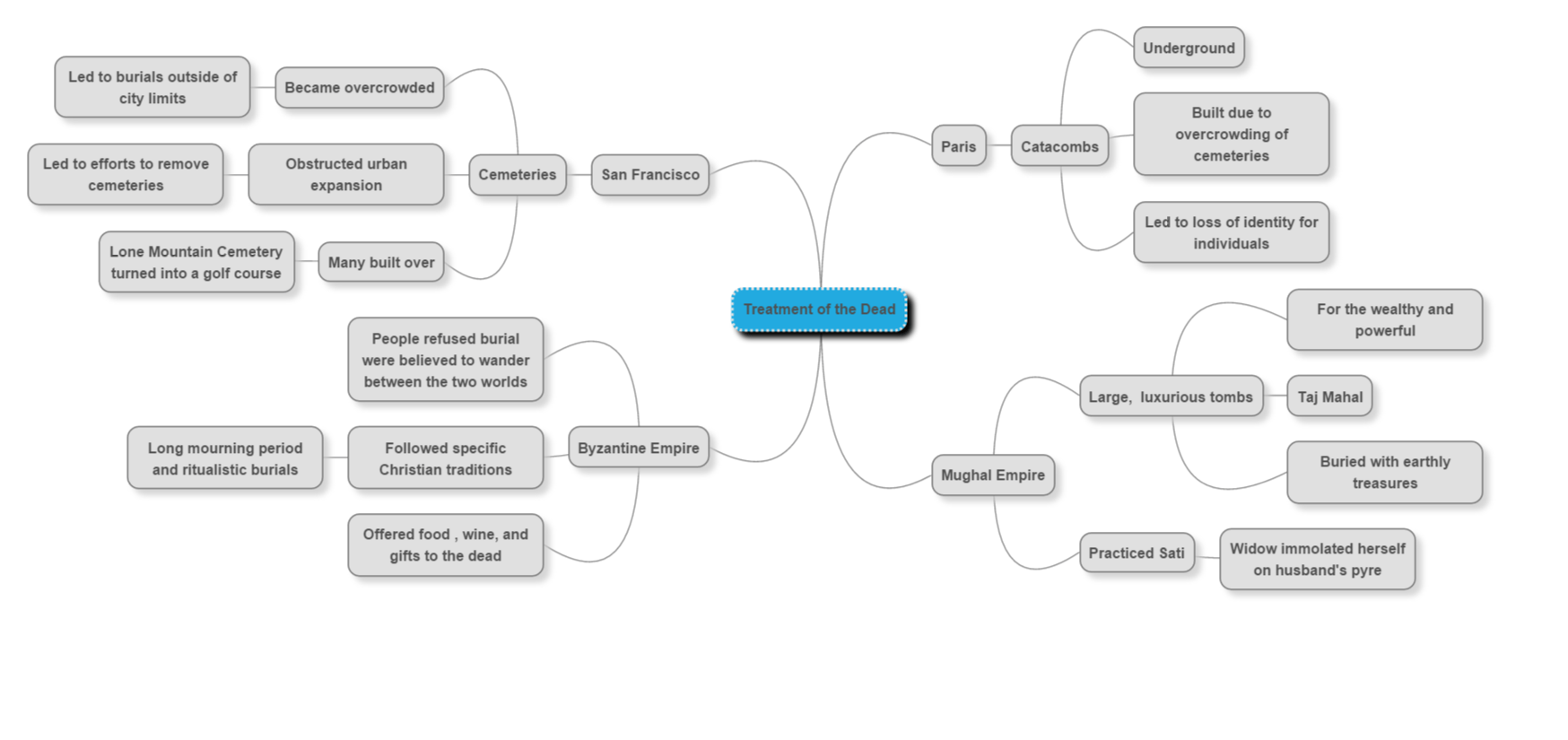
For my concept map, I chose to compare and contrast the treatment of the dead between some of the cultures we have been learning about in modules 4 through 6. I focussed on the catacombs in Paris, the issue with overcrowded cemeteries in San Francisco, and the burial practices in both the Byzantine and Mughal empires. From what I discovered, it is interesting that a process that was held so sacred in ancient civilizations is now seen as an inconvenience to modern life. While the massive Taj Mahal was built for the burial of a single person, in Paris the remains of thousands of people were combined into catacombs and in San Francisco one of the biggest cemeteries was turned into a golf course. It seems as though death is becoming less of a sacred topic, and more of a problem and nuisance in modern society.

Concept Map

Filed Under: 0.0 Concept Map Assignment, Group 4

Concept Map Assignment

February 28, 2016 by petewcook Leave a Comment

Hey y’all. I thought I would dive deeper into what I noticed between Hagia Sophia and Japan’s Ise Grand Shrine. Hagia Sophia was built as a Christian Orthodox church 3 times. The cultural beliefs were to have mosaics, paintings, beautiful architecture, etc. for this structure. It was habit to build from marble, brick, and long-lasting materials so the structure would last a very long time, or at least that was the intent. As a mosque the structure was also changed so that it incorporated the beliefs and habits of the Muslims such as Minarets, Mihrab, medrese, Imaret, Sadirvan, etc. There was no belief of renewing the structure though, because it was built to last each time it was built. These two religions valued superb Byzantine architecture, the mosaics, the paintings, the structure as a place of worship (church and later mosque), and the great minds that built these structures. At one time this structure was the largest cathedral in the world for over a 1,000 years.

On the other hand we have Japan’s Ise Grand Shrine. Japan had a different take when it came to one of their most sacred shrines. Somewhere in the 680’s A.D. Emperor Tenmu established the Sengu ceremony tradition of rebuilding the shrine every 20 years in order to make the shrine last “forever”. The cultural beliefs were to preserve and hand down traditional skills and crafts to the succeeding generations and convey the roots of Japanese culture. The cultural habits were to rebuild the shrine with wood, thatch, etc., simple materials that could be reused and renewed for many generations to come. Sacred treasures were moved to the new shrines and they would worship in these shrines for another 20 years until it was time to renew them. Some of the values from the Japanese were the crafts and skills of carpenters and other artisans to be passed down to the next generations, renewing their structure so it would last “forever”, and to continue their culture through this practice from generation to generation.

Pete CookNew-Mind-Map_52tcylob

Filed Under: 0.0 Concept Map Assignment, Group 2

  • « Previous Page
  • 1
  • …
  • 44
  • 45
  • 46
  • 47
  • 48
  • …
  • 97
  • Next Page »

Students

Log in here.

Groups

Student Contributions

From the Professor

Copyright © 2026 · Minimum Pro Theme on Genesis Framework · WordPress · Log in