HIST 100: Engineering The Past

  • Home
  • Syllabus
  • Schedule
  • Blog

4.1 Hagia Sophia

February 20, 2016 by petewcook 1 Comment

Hey y’all Pete here. The purpose of this post is to tell you a little about the architectural features of Hagia Sophia. These features were added onto the structure during it’s time as a Mosque from 1453-1935.

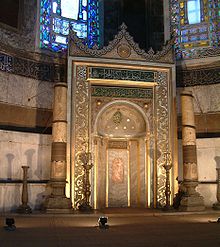
Prior to 1481 a small minaret was built above the stair tower on the southwest corner of the building. Later, another minaret at the northeast corner of the building was built by the succeeding sultan, Bayezid ll (1481-1512). After the Earthquake of 1509, one of the minarets collapsed and near the middle of the 16th century two diagonally opposite minarets were built at the east and west corners of the building in place of the old ones. The first minaret by the southwest corner was built from red brick while the other three were built from white limestone and sandstone. The two larger minarets were built by Sultan Selim ll and designed by Mimar Sinan, the famous Ottoman architect. During the 16th century, Sultan Suleiman the Magnificent returned to the structure with two massive candlesticks from his conquest of Hungary. They placed these on either side of the mihrab. In 1740 under Sultan Ahmed lll, a Sidirvan, fountain for ritual ablutions, was added to the structure. A new mihrab was also added at this time. During the Renovation of 1847 the minbar and mihrab were renovated and the two minarets were also set to equal heights.

Filed Under: 04.1 Hagia Sophia, Group 2

Hagia Sophia

February 8, 2016 by indeabennett Leave a Comment


I chose Byzantine science for my topic, though it does fall more into a cluster. This is because Byzantine science includes medicine, mathematics and military weaponry well as other aspects. The Byzantine were on of the firsts people to compile medical information into textbooks standardizing the way they treated the ill. Byzantines also adopted a non-military hospital for treating the sick which wasn’t as common. Along with this plethora of knowledge was the complex works of ancient Greek mathematicians. It’s this information that was studied and in part is credited to Hagia Sophia’s timeless structure.

2424938134_9be552da57_m

During this time (as is still the case) science was devoted larely to the military and how it could aid in both defense and conquest. The Byzantine used an incindary weapon called ‘greek fire’. A complex mixture of hydrophobic materials that could be used in naval warefar because of its ability to burn on water. The Byzantine valued knowledge and as such gathered their information to become a prominent port of information to the western world.

7998416422_c149718c82_m Which raises the question what does this have to do with Hagia Sophia. Well to start with Byzantine science , a collection of scientific observations from cultures like the Greek and more, were responsible for a large influence of the Renaissance. As well as providing ancient Greek texts on astronomy and mathematics they were a prominent source of scholars. Not only did Byzantine science influence a major cultural moment but also the architects responsible for building Hagia Sophia.

3840925177_481d0e9b37_m

Hagia Sophia. Digital image. Flickr. Yahoo!, 2012. Web. 08 Feb. 2016.


Filed Under: 04.1 Hagia Sophia, Group 2

Hagia Sophia- Architectural Features

February 4, 2016 by madisonklein 2 Comments

The Hagia Sophia is one of the most interesting and mysterious buildings left from the ancient world. It’s enormous size and ability to withstand 1500 years of earthquakes is under investigation. The building reached completion in the year 537. The ceiling stands 180 feet high by 100 feet across. The core structure of the building is the enormous main dome supported by four arches. On each end, their are two semi-domes backed by four giant pillars. It’s main architectural features include the nave, exedra, narthex, apse, and parapets. A nave is an enormous main room; in the Hagia Sophia, this is the area beneath the largest dome, with smaller domes above. The exedra is a semicircular room with benches; its purpose could be worship or conversation. There are exedras built off of the east and west domes in this structure. The narthex is located at the entrance; this is reserved for an emperor, and has a long ramp that leads to the upper gallery. A Byzantine mosaic of Christ and an unknown emperor is above the narthex.  The apse is a large recess at the east end; it is reserved for an altar. Above the apse is a magnificent mosaic of the Virgin Mary. Finally, the Hagia Sophia contains marble parapets that make up the ledges; they are up to 60 centimeters thick. The interior contains polychrome marbles, green, white, and purple porphyry, and nearly four acres worth of gold mosaics.


Sources:

https://en.wikipedia.org/wiki/Hagia_Sophia#Apse_mosaics

https://en.wikiarquitectura.com/index.php/Hagia_Sophia#Alzado


The layout of the Hagia Sophia.

 The mihrab in the apse.

 The tall ceiling of the nave.


Filed Under: 04.1 Hagia Sophia, Group 5

  • 1
  • 2
  • 3
  • …
  • 6
  • Next Page »

Students

Log in here.

Groups

Student Contributions

From the Professor

Copyright © 2026 · Minimum Pro Theme on Genesis Framework · WordPress · Log in