By: Jake Sparhawk, Amanda Lennox and Madison Klein
The origin of the Inca Empire comes from a tale of four brothers and four sisters who emerged from a cave and set out to find where there people would live. One of the brothers named Ayar Manco carried a golden staff, and wherever the staff landed, a city would rise. The staff landed in Cusco, the “navel of the universe”. This was essentially the capital of the empire, and served as a political, military, and administrative center. The Inca empire was the largest pre-Colombian empire, and was divided into four different “suyu”, or regions: Chinchaysuyu, Antisuyu, Qullasuyu and Kuntisuyu. The empire as a whole was referred to as Tawantinsuyu. Beginning in the early 13th century, the empire lasted until 1572 when the strong Spanish army took over. It stretched from the Andean Mountains into Peru, Ecuador, west and south central Bolivia, northwest Argentina, north and central Chile, and south Colombia. Officially, the language spoken was Quecha, but there were variations based on region. Incan’s were allowed to practice different types of religion, but most practiced polytheism(16).
In contrast, the Aztec Empire began as an alliance between three city-states in the Valley of Mexico: Tenochitlan, Texcoco, and Tlacopan. It existed from 1428 until Spanish conquer in 1521. The original people were called the Mexica, but the empire was a compilation of as many as 17 ethnic groups. The alliance was a conquering group; they began gaining control of surrounding areas quickly, and at one point controlled most of central Mexico(15). The city of Tenochitlan held a large part of the power, serving as the military power(17). The Aztecs allowed the current rulers of the regions they conquered to remain in power though. Nahuati was the main language spoken in the Aztec Empire. They, too practiced polytheism(18).
When comparing the Aztec and Inca empires with relation to their sacred structures, religion is the fundamental key in both. In Inca religion, sacred sites, or huacas, were spread most usually in natural objects such as mountains, boulders, streams, battle fields or any type of place that was connected to the past Inca rulers(14). Most believed that their ancestors rose from things that trees or rich soil. The most familiar Inca site is a city called Machu Picchu. It is a city that was built in the Andes Mountains at the very top of a mountain(4). It was built very carefully and tactfully including terraces that allowed for rainfall to safely reach the bottom of the mountain without creating mudslide. One belief of why the Incas chose mountain tops was to align with the rising and setting of the sun. To the Incas, they had a God named Inti, who was the source of warmth, light and healthy crops (12). When they conquered new lands, they required the conquered citizens to also worship Inti. In every region, temples were built to worship Inti, and while they made other worship their God, they also accepted their Gods into the Inca pantheon(12). The Incas had a ritual called Inti Watana Stone where the stones were to be arranged in such a manner that they pointed directly towards to sun during the winter solstice. They believed that the stone was to hold the sun in place(20).
Both empires have scared structures that reflect their beliefs. The Aztec built several types of pyramid structures that either served as monuments for their many god or as ceremonial shrines to perform rituals.(3) There are Round Pyramids that are dedicated to the god of wind, Ehecatl, one of the forms of god Quetzalcoatl. The shape was used in order to prevent the structure as a “barrier” of the wind god’s entrance. Going on about the wind, they had a purpose for each type of wind the blow over the pyramid. The gentle winds were sent to the east where the god of paradise, Tlalocan, resided. Winds that possessed gales were sent to the underworld, Mictlan, in the north. Cool gentle breezes blew to the west, where Cihuapipiltin, a woman who died giving birth, stayed. And finally, winds that had a strong and gusty wind were sent to the south where the Huitznahua gods, the stars of the south, resided(3). The next type of pyramid were the twin star pyramids. These pyramids were used to house two deities, the god of good rain season and an abundant harvest, Thlacan, and the god of war and sacrifice, Huitzilopochtli. The two each had separate temples on the top of the pyramid. Thlacan had the temple on the left side and was painted in a blue and white colors in order to represent water and moisture. Huitzilopochtli’s temple was on the right side and was painted similar to Thlcan, with red being in the place of blue representing blood. The Aztecs relied heavily on these structures, as the gods controlled whether the season will yield a famine or not so they built the pyramids in order to be as close as they can to the sky, which was where the gods lived(3).Because of worship of many gods, they built shrines or Adoratorios. Since they were polytheistic, each shine had a different yet similar structure, depending on the god it was built for. The similar design was that each shrine had a circle table of which the offering was placed before the gods. Since the amount of sacrifices were immense, some structures were created in order to burn the offering in a fire, in order to make room for more. These structures were possibly the most influential in the Aztecs lives, as they truly believed that sacrifices would please their gods(3).
Although there are differences between the Aztec and the Inca empires, both had similar beliefs about worshipping, war and strategies to run the empires. They both were sacred to their beliefs with religion. Both empires believed in sacrifice(13), the Aztecs more so when dealing with human sacrifice. It was a honor to die for their Gods. When the topic of war is at place and their goals, both empires battle wars hopes were to take captives and expand their empire(13). The armies were a key figure in keeping the empire strong and maintained. Both ran the economies not based off of money, but off of agriculture, labor and goods(13). The Aztec empire ended up lastly a lot longer than the Inca empire but within time, both empires were conquered by the Spanish(13). Both empires are still looked at to this day as a great way to learn about the way of life at that time. Their structures can tell us about the way the lived, how to worshipped or how they ran their empire. Although the Incas did not have any written language, they managed to create a city on top of a mountain that has lasted around 500 years. Thankfully these empires were not forgotten so we can now reflect on their ways of living and engineering and help us to better ourselves for present and future generations.
1.http://blogs.harrisonhigh.org/shannon_herndon/herndondocs/11%20-%20aztecincacomparison.pdf
- Mark Cartwright, Aztec Art, January 6 2014. http://www.ancient.eu/Aztec_Art/
- Manuel Aguilar-Moreno, Aztec Architecture.http://www.famsi.org/research/aguilar/Aztec_Architecture_Part1.pdf
- Mark Cartwright, Machu Picchu, March 4 2014. (http://www.ancient.eu/Machu_Picchu/
- Mark Cartwright, Inca Architecture, March 13 2014. http://www.ancient.eu/Inca_Architecture/
- Sacred Sites https://sacredsites.com/americas/peru/machu_picchu.html
- G. Wayne Clough, The Earliest and Greatest Engineers Were the Incas, January 2014. http://www.smithsonianmag.com/magazine/earliest-and-greatest-engineers-were-incans-180947976/?no-ist
8.Inca Engineering http://dwb.unl.edu/teacher/nsf/C10/C10Links/ericir.syr.edu/Projects/Newton/14/incaengineer06.html
9.William R. Fowler, Inca Empire, 2000. http://autocww2.colorado.edu/~toldy3/E64ContentFiles/HistoryOfTheAmericas/IncaEmpire.html
10.Info Please http://www.infoplease.com/encyclopedia/society/inca-inca-agriculture-engineering-manufacturing.html
11. Wikipedia https://en.wikipedia.org/wiki/Inca_architecture
12.Gale World History in Context http://ic.galegroup.com/ic/whic/ReferenceDetailsPage/ReferenceDetailsWindow?zid=0815c7ada1a697f9c22b70286fbe1330&action=2&catId=&documentId=GALE%7CCX3424400021&source=Bookmark&u=mlin_s_thayacad&jsid=86fda428b204e3b67fcc23cfaf48fbe5
- Ashley Birmingham, Aztecs and Incas compared politics and economy, December 6 2013.http://www.slideshare.net/abirmingham/aztecs-and-incas-compared-politics-and-economics
- Machu Picchuhttp://www.machupicchu.org/religious_significance_in_machu_picchu.htm
- Wikipedia https://en.wikipedia.org/wiki/Aztec_Empire
- Wikipedia https://en.wikipedia.org/wiki/Inca_Empire
- Aztec-History http://www.aztec-history.com/aztec-empire.html
- Aztec-History http://www.aztec-history.com/aztec-civilization.html
- Aztec-History http://www.aztec-history.com/ancient-aztec-religion.html
20. Wikipedia https://en.wikipedia.org/wiki/Machu_Picchu

The Aztec Pyramid (15)

Sacsayhuaman (16)

Macchu Pichu (16)

 The layout of the Hagia Sophia.
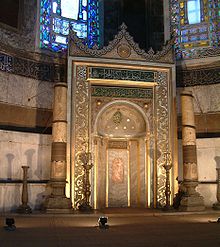 The mihrab in the apse.
 The tall ceiling of the nave.