Irrigation provides water for agriculture and farm land. When settlers were exploring the country, there was land that was not ideal for dry farming, and did not receive enough rain throughout the year to be prosperous. Irrigation is a controlled application of water to land, mainly for agriculture, through handmade devices to make up for the need of water that is not fulfilled by natural rainfall. Having developed irrigation canals and ditches has allowed Idaho to be successful in farming, and able to provide the country with produce.
Finding ways to regulate water usage was not something that came naturally. As Mormon settlers became more prominent in Idaho, they were bringing water technologies they adapted from the Pueblo Indians with them. Southern Idaho is an ideal place to have farmland for potatoes, hay, wheat, and for livestock raising. (1) In order to grow a greater variety of produce there needed to be a greater amount of water. Once all of the land that had easy access to water was taken up, companies began to pop up to build canals and ditches.
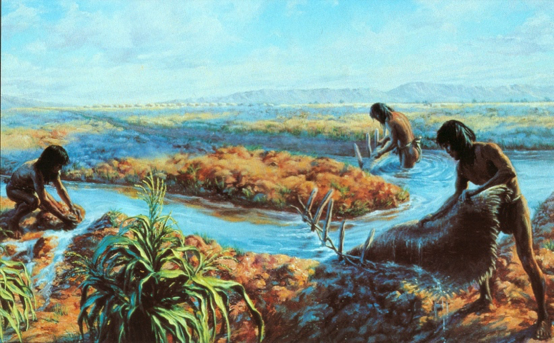
A painting of Pueblo Indians irrigating
Pueblo Indians developed irrigation and it was later adopted by settlers in the area.
In 1300 CE the natives, The Pueblo, lived in American Southwest. The Pueblo had originally been hunter gatherers but their dietary needs began to shift to growing food, in this area their primary food was corn. Because of a dry period during this time they began to build terraces and dams to conserve soil and water so they could continue to grow their crops. Finding ways to bring water to them extended their livelihood, however there are theories that suggest they could not over come the drought and the famine, or possibly diverting the water led to conflict with others in the area. (2) The methods they used in the West helped pave the way for many settlers to adapt possible ways to help them.
Having large amounts of land without water and a lack of companies to build these canals began to be a problem in many places. Under the Desert Land Act, also known as the Carey Act, the United States gave land to the states to give to farmers that could irrigate it and turn it into farmland. The growth of irrigation grew from the Newlands Act that created the U.S. Bureau of Reclamation. The Bureau utilized the Snake River, building many dams and canals off of it.
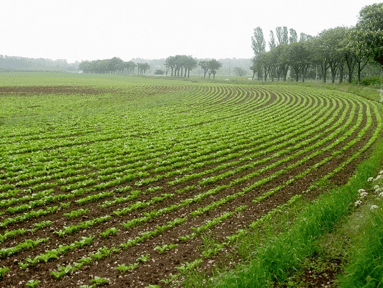
Sugar beet farm
It is important for these farms to have access to water because Idaho is a major producer of fruits and vegetables throughout the country. Not only does Idaho supply the most potatoes in the country it supplies the third most barely, sugar beets, hops and mint. (3) By adopting and utilizing irrigation all regions of the state have become successful producers, making the growth of irrigation so significant.
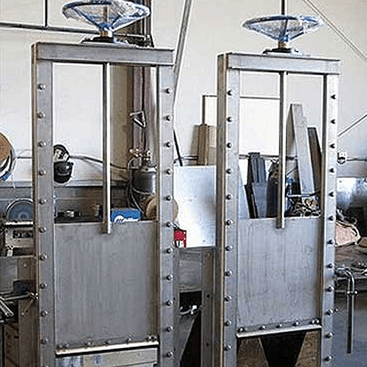
Gates to open and close irrigation canals
In communities with irrigation canals those that have decided to use the water for flood irrigation have a set time they are allowed to keep the water. When it is the water user’s time to take the water user will lift or open their irrigation gate to direct the water to their property. Once their allotted time is up the farmer or land owner must go outside and shut off the water to send it down the way to the next property. These gates that are used can range from small boards being lifted and moved, to large cranks that are controlled by wheels to lift and lower the gate. In farms with more modern technology they use computer controlled and buried pressurized water pipelines or sprinklers. (4) This new way of irrigating is much more efficient, especially on farms with large amounts of land. By having it computerized there is not worry of someone not keeping an eye on the time and not passing down the water when needed. Farmer’s assess the needs they have for irrigation, and chose which irrigation method is most beneficial for them. One of the most visually recognizable forms of irrigation would be the center pivot method, this is an automatic technique the water is dispersed from sprinkler heads and on average covers about 130-acre circular area. (5)
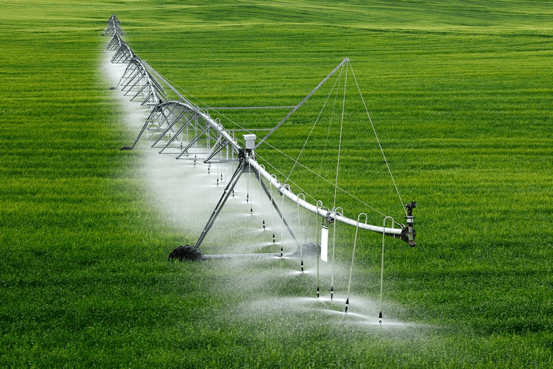
A central pivot sprinkler
However beneficial this method of water transportation is there are always some concerns that come with it. The canals and ditches that house and transport the water are deep and fast moving. In the summer months it is common for people, commonly children, to seek them out for a refreshing swim. These canals are deep, fast moving, and often made of cement which makes it easy for someone to get swept away in the current and unable to get out. If someone were to hit their head on the side of a canal or get caught in a gate it could be fatal. Since irrigation canals are so prominent in southern Idaho there is an Irrigation District Canal Safety Recognition Week to inform residence of the dangers.
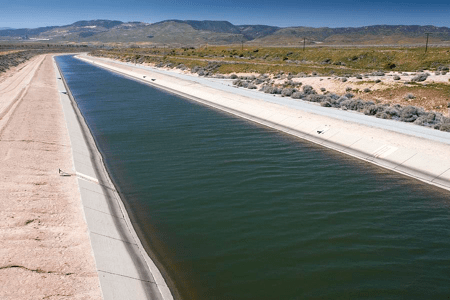
An irrigation canal with high cement walls making it dangerous for any swimmers
People in many different cultures know the importance water is to creating a successful civilization. There have been engineering and developing of many different methods to bring water to these people. Idaho and many other western states would have different environment had irrigation not be utilized and adapted to fit the areas needs. Southern Idaho would still have crops, but not the large variety that there is today.
Works Cited
1. http://imnh.isu.edu/digitalatlas/geog/agirrig/agirtext/agigmain.htm
2. http://www1.american.edu/ted/ice/anasazi.htm
3. http://imnh.isu.edu/digitalatlas/geog/agirrig/agirtext/agigmain.htm
4. http://www.agr.gc.ca/eng/about-us/offices-and-locations/canada-saskatchewan-irrigation-diversification-centre/about-the-centre/?id=1186152258980
5. http://water.usgs.gov/edu/irquicklook.html